
The Meaning-Filled Behavior of Animals — What We Can Learn From Birds
Craig Holdrege
From In Context #55 (Spring 2026) | View Article as PDF
On a June morning at the edge of a meadow near The Nature Institute, it’s possible to witness the doings of various birds. The fast-flying tree swallows bank in tight curves in their search for insects. Bobolinks fly up out of the grasses, chase one another, and then separate off with fluttering wings and bubbling song. A few turkey vultures soar high above the meadow, hardly flapping their large, broad wings. On a rare occasion, a kestrel, the smallest of our falcons, hovers in the air with rapidly fluttering wings and then suddenly falls like a rock into the field, only to wing upward again. Each of these species reveals a unique and specific form of being a bird. Observing them, I can live into the specificity of its body, its movements, its vocal expressions, and its relation to the air, to the meadow, and to other animals.
The more deeply I immerse myself in these different ways of being, the more difficult it becomes to imagine a swallow soaring ever higher without wing strokes in the way of a vulture or hawk, or a vulture making the rapid and tight directional shifts of a swallow. There is a fundamental agreement of bodily configuration and behavior that we find, and then learn to expect, in animals. I can as little expect a horse to climb cat-like up into the limbs of a tree as I can expect a mole to leap in deer-like bounds across the meadow. That all seems obvious. Yet what is obvious and seemingly straightforward often harbors riddles that can, when given due attention, lead to greater insight.
In this essay, I want to explore some of the relations between an animal’s bodily configuration and its behavior, and the connection of these with what we think of as an animal’s environment. Can we see how they belong together as aspects of an integral whole?
The Unity of Forming and Form in Body and Behavior
Most birds develop over the course of a few weeks from a single-celled zygote into a highly differentiated embryo. Most of this transformation occurs within the calcified egg shell after the mother has laid the egg in the nest and begins to brood the eggs. By the time it is ready to hatch, the embryo takes up most of the space within the egg shell. How does it free itself from this solid protective mantle that has been crucial for its development up to that time? The calcified egg shell becomes thinner during embryonic development and its partial dissolution provides a main source of calcium for skeletal formation in the embryo. One special structure develops on the top and toward the tip of the beak. It is sharp and pointed — the egg tooth. (Other than this tooth, birds have no teeth.) A strong muscle at the back of the neck forms simultaneously with the egg tooth. When the time to hatch has come, the embryo — with the help of its new organs — pecks with the tooth at the inside of the egg shell until little holes arise. It breaks out of the shell and enters the new world of the nest. Soon after hatching, the egg tooth either falls off or is reabsorbed (depending on the species) and the hatching muscle regresses (Clark 1961, Gill 2007, pp. 460-62).
Here we see an instance of the tight and highly meaningful relation between organ formation and behavior. The organs — in this case the egg tooth and the hatching muscle — arise in a specific period of the animal’s life and the animal engages in activities that the specific organs allow. Once this developmental phase passes, the organs and behavior disappear. It is clear that the forming of the organs and the emergent behavior are intimately related. Are we justified viewing them as two manifestations of the same agentive process? If so, we can say: The unitary being of the developing bird is first active as an organ-forming agency. Then, once the organ is formed, a new quality of active forming emerges, namely, the specific behavior of pecking. One being expresses itself in two forms.
Nestlings that hatch naked and blind, which includes most all songbirds, beg for food by making loud calls and opening their beaks wide. Here the behavior, which is rooted in the development of the still unfinished body, elicits food-finding and food-bringing activity of the parents. The parentally served nourishment is in turn necessary for further development and maturation of the nestling’s wings, muscles, feathers, senses, and internal organs. After two or three weeks the young bird is ready for the next phase of life, which begins when it takes flight from the nest.
We see in these developmental processes the intimate connection of bodily forming and behavior. Formed organs provide the basis of specific and meaningful behavior, and meaningful behavior elicits processes that stimulate new organic developments and provide the basis for new behavior.
To underscore this unity of body and behavior, we could view the formative processes that generate new organs as organ-forming behavior that morphs into organ-using behavior. Or to put it differently: The animal is a being-at-work; it is formative activity. When the organ-forming activity has come to a certain completion or culmination, the specific modes of motor activity and sensory awareness commence and an animal shapes its relations with the environment to which it belongs.
The Wisdom of the Bodily Organization
A bird does not try to fly until its organs and physiology have developed to the degree that make flight possible. You only have to look at some aspects of bird anatomy and physiology to stand in awe before the organic wisdom that they embody. For instance, when the feathers are mature, they have become highly refined structures that are hollow and very light. If you find a feather, hold it at the quill and move it gently downward. You can feel, via the feather, the resistance of the air. Many hundreds of feathers form the plumage. While all feathers have the same basic structure, they vary greatly. Small fluffy down feathers are wonderful insulators. Wing feathers have a configuration that allows flight and, at the same time, enables the bird to perceive and modulate within the constantly changing medium of air that is its home during flight.
Many of the bones of the skeleton also become hollow. The air sacs that branch off of the lungs ramify into the hollow bones and the spaces between the organs. All this contributes to the overall lightness of a bird. The special relation to air shows itself in lungs that are structured like no other respiratory organ in the animal kingdom. Due to their connection with the air sacs, the lungs receive fresh air both when the bird inhales and when it exhales (Maina 2025).
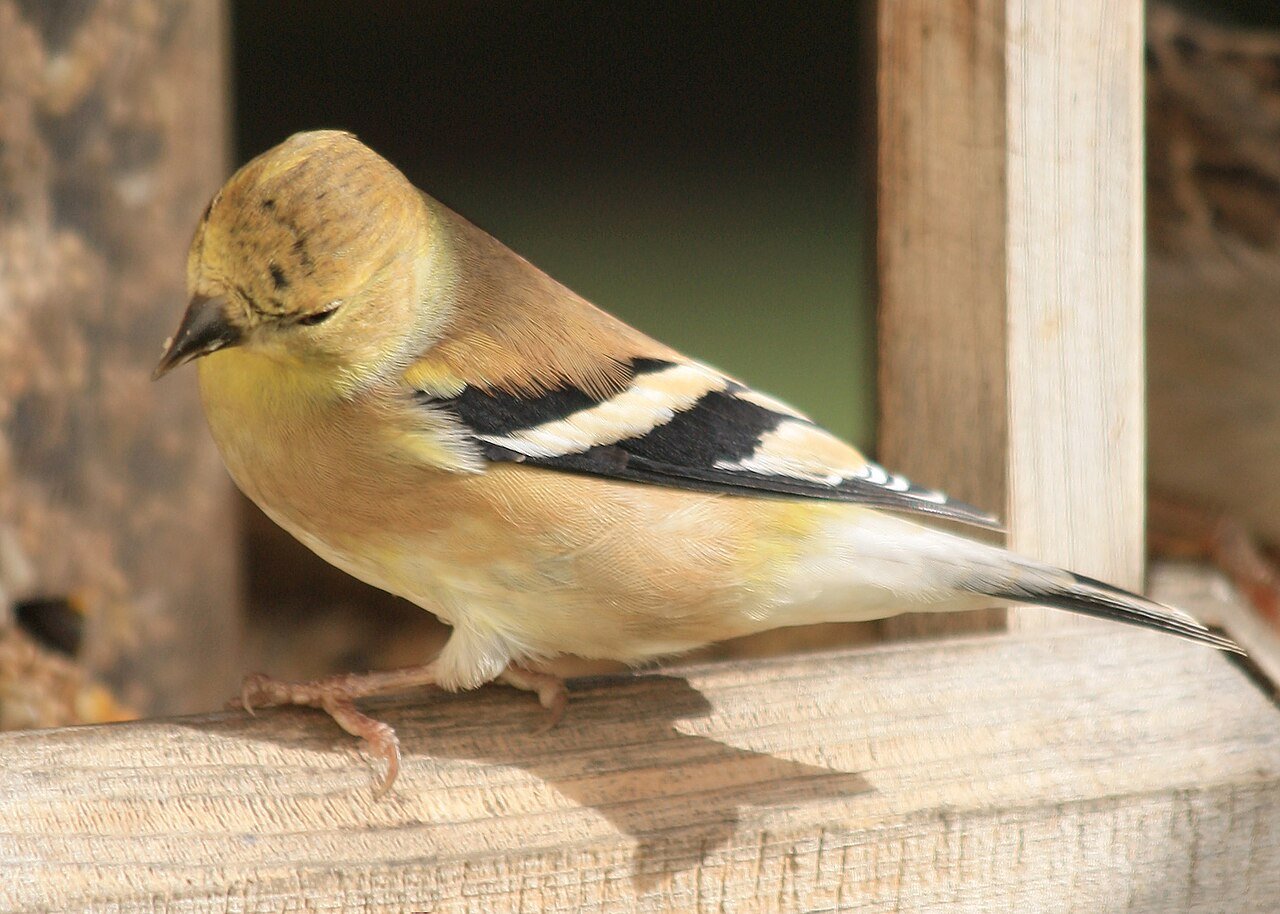
Figure 1: American Goldfinch male in non-breeding (left) and breeding plumage (right). (Photos: Wikimedia commons)
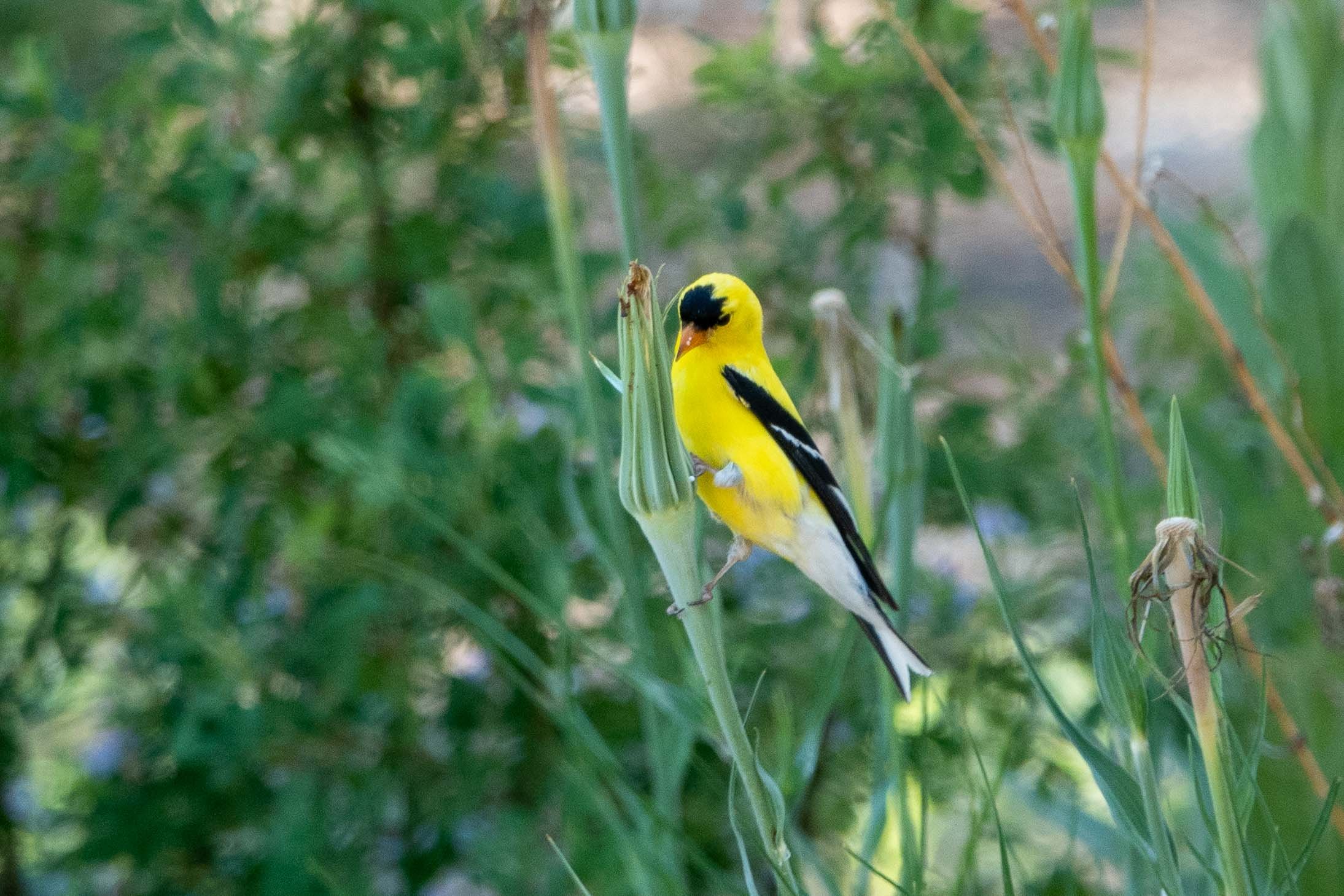
Once bird feathers have developed and taken on their final form, they do not grow any more. They age over time, fall out, and are replaced. This is called molting. It can occur over many weeks and usually every feather is replaced. Most birds remain active flyers while molting. In many birds, males and females look alike during a good part of the year, but, at some period before the breeding season, the males molt and develop a different plumage pattern with often striking colors (see Figure 1). What is remarkable in these cases is that the same follicle that previously brought forth a feather of a specific coloration after the molt brings forth a feather with wholly different coloration. Moreover, all the new feathers together are integrated into a unified plumage pattern. Individual feathers overlap in the plumage and often only that part of the feather that is visible has the coloration that constitutes the plumage pattern (see Figure 2). Surprisingly, blue and green colors in bird plumage are not pigment colors (red and yellow are). They are created by the structural configuration of the feathers — an intricate interplay of structure, darkness, and illumination (Portmann 1984 chp. 4, Prum 1999).
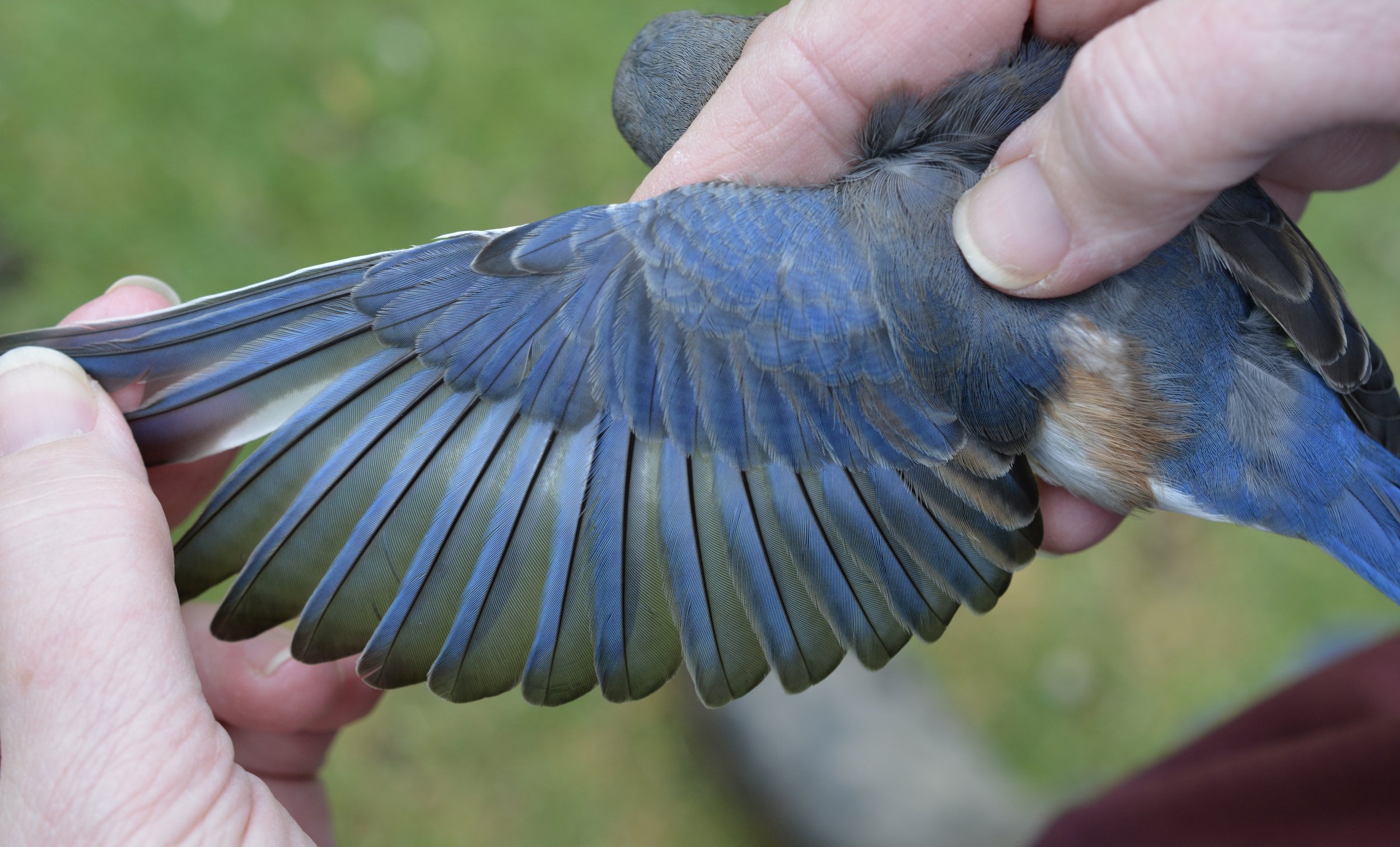
Figure 2. Wing of a female Eastern Bluebird with feathers spread apart while being banded. Only that part of each wing feather has the rich blue structural color that appears when the wing is in its normal state. (Photo: Use with permission)
Body-Behavior-Environment
The features I have described so far point to the profound and refined organic activity that brings about the remarkable integrated structure of an animal body. When Goethe states that “animals are taught by their organs” (1973, p. 443), he has before his mind’s eye the embodied organic abilities without which there could be no eagle that soars on thermals ever higher in the sky, and no glistening hummingbird that hovers in place with wings flapping up to 80 times a second while drinking nectar from a flower through its long beak. The specific array of an animal’s behavior is anchored in the living configuration of its body. Or we could say, behavior is the morphing of this living configuration into a new realm, namely, specifically shaped activity in the world. This unity of bodily organization and behavior has been referred to by some authors as instinct (Bockemühl 1977, Buytendijk 1938, Steiner 1995, chp. 4). It is a restricted use of the term and is distinct from the more typical general usage in which “instinct” encompasses all unlearned behavior.
Let’s revisit the different birds I encountered while in the meadow — the soaring vulture, the rapidly circling swallows, the fluttering and vibrantly singing bobolinks, and the hovering and diving kestrel. Each is a creature of the air, yet the way each one moves in the air, and the way the air moves them, is both species and situation specific. The meadow for the bobolinks is a place to rest and nest, and above which they fly and interact with each other. It is home of the prey for the kestrel, a place to scan from above, to rapidly enter and leave again, hopefully with a mouse or vole in its beak. For the swallow, the air above the meadow is where it finds its insect prey — sometimes close to the plants and sometimes high above the meadow. It does not enter into the plant realm the way bobolinks or kestrels do. The only situation in which to encounter a vulture in the meadow is when there is an animal carcass that the vulture has either caught sight of or smelled from high up and on which it is now feeding.
Animals are special in that their behavior is so fully in accord with their bodily organization. It is, on the one side, limited and constrained by the body’s specialized configuration and, on the other side, each animal’s particular abilities are enabled by the configuration of its body. Animals do not strive beyond their “suchness.” This by no means implies that the behavior is “automatic” or “mechanical.” Behaving is always a formative activity.
The features of the world that enable and are part of an animal’s life — that show up for it, that it is drawn to or repelled by, that it changes or incorporates or is changed by — are all interwoven with its specific bodily-behavioral configuration. Its relations to world constitute its “environment,” and that environment belongs to it. Just as injured or diseased organs can compromise an animal’s life, so can an insufficient environment. Without meadows, bobolinks cannot build nests and propagate. Animal species are often driven to extinction through the destruction of their environments — not by direct eradication.
Rhythmic Life
While an adult bird has, theoretically, the capacities to fly, feed, sleep, or sing at any given moment, it doesn’t. One important way in which its life takes shape is within world rhythms — mainly daily and yearly rhythms. (For aquatic animals, lunar rhythms are also often significant.)
In the northeastern U.S. where I live, songbirds begin to sing, mainly at dawn and dusk, in late winter — when the days are becoming longer, yet it is still cold and wintry. It is only after the spring equinox, into April and May, that songbirds here become territorial, mate, build nests, brood the eggs, and then care for their young.
The progression of these behavioral activities is connected with bodily changes. The increase in day length in the spring stimulates, via hormones, the development of the gonads. The birds then exhibit new behavior — establishing territories, courtship, mating, and nest building. After the breeding season, when the days are long, the gonads usually shrink and, in a sense, take on a juvenile state that persists until the following spring (Dawson et al. 2001).
Typically, after mating — while the eggs are developing and during nest building — the bird that will incubate the eggs, which in songbirds is usually the female, begins to lose feathers in a patch of skin on the belly. The outer skin thickens, the underlying tissue swells, and a high concentration of new blood vessels develop. When the eggs are laid, the parent sits on them and, thanks to the naked brood patch, warms them with her own bodily warmth. The amount of blood that flows through the patch can be modulated as needed. As with the gonads, the development of the brood patch is associated with hormonal changes. It disappears after the breeding season (Jones 1971).
Many long-distance migratory birds arrive here in May. The northern late spring and early summer is their breeding season. After the breeding season, they depart south again, long before fall arrives. They are sensitive and responsive to changing day lengths. Sometime after the summer solstice, when day length slowly decreases, migratory bird physiology shifts to allow the bird to store extra fat in their body. At some point in time they display what is known in captive birds as “migratory restlessness” and commence their migration southwards (Gwinner 1977). It is quite remarkable that most migratory songbirds, which are ‘day’ birds during the breeding season and also during their time in the south, migrate mainly during the night. Migration can involve hundreds of miles of nonstop flight during which the birds rely on their fat reserves.
Bobolinks, to share a specific example, start their flight south usually sometime in late July or August. They usually fly toward coastal southeastern U.S. and fly over the Caribbean ocean to Venezuela and Colombia. They remain there for some weeks and then commence the final leg of their journey to their destinations south of the equator in Bolivia, northeastern Argentina, Paraguay, or western Brazil (Renfrew et al. 2015). They leave the north when the days are still long and arrive in the south when the days are also long. As in the north, they seek open fields as their habitat. This can include agricultural habitats such as rice fields. In the south they do not breed. Around southern fall equinox (late March) they begin their flight back north. They arrive every year on a field next to The Nature Institute during the first week of May. Many years I saw them for the first time on the morning of May 4.
Migration is one of the wonders of bird behavior and a highly rhythmical phenomenon that is integrated into the rhythms of day and year in different parts of the planet. What is typical for long-distance migrants is that the end points of their migrations are places on earth with long — and in many cases warm — days. The most extreme migrants, such as the arctic tern, fly from the very long (and cool) days of the northern polar summer to the very long (and cool) days of the southern Antarctic polar summer. They pendel between similar habitats and long days at opposite ends of the earth. As Scott Weidensaul writes in his book on bird migration, it “is the one truly unifying natural phenomenon in the world, stitching the continents together in a way that even the great weather systems, which roar out from the poles but fizzle at the equator, fail to do” (Weidensaul 1999, p. x). Extensive research has shown that when migrating, birds relate to geographical landmarks, but also to the shifting position of the sun during the day and year, to the magnetic field of the earth, and, in those birds that fly at night, to the starry heavens (Berthold 2001, Rappole 2013, Weidensaul 1999). It’s appropriate to think of migratory birds as earth-spanning beings that connect the physically distant and distinct parts of the earth through their annual migrations. Large parts of the earth belong to their home, and this home includes the earth’s magnetic field, the sun, and the starry sky.
Behavior and the Present
I have so far focused attention, first, on the organic wisdom of the bird’s bodily organization and this organization in relation to behavior. Just as the body is specialized, so is the behavior. And they are of one cloth — two connected, yet different, expressions of its animal nature. Second, I considered how the meaning-filled behavior of birds is embedded within rhythmic processes, primarily daily and yearly rhythms. This gives behavior the quality of ebb and flow, of an ordered, yet changing, temporal existence. There is a specific form or gestalt to behavior in the way it comes and goes over time.
We now need to consider a third essential feature of behavior, namely, that the animal’s activity occurs in the now, in the present moment. Yet, what the animal does in the moment is highly dependent on the past it brings to the present — its bodily configuration and its current disposition related to the flow of time. A male chickadee in the winter easily associates with other male chickadees. When mating season comes, however, it keeps distance from other males and if one comes too close, he chases them away. For most of the year a feather on the ground may be of no significance for a house wren, yet at the time of nest building it is perceived, taken into the beak, and molded carefully into the nest. You could say that a feather on the ground does not enter the bird’s world until that bird has a certain disposition through which it is open to the feather and capable of incorporating it into its life in a meaningful way, that is, within the context of nest building.
It’s true that a nest-building yearling bird lives out an embodied capacity that comes to the fore at a certain time of year. It does not require previous learning from the parents. Yet the bird is building a nest out of sticks, grass blades, feathers, or perhaps pieces of plastic that it has never encountered before. In this sense, it is dealing with a novel situation. It has to navigate in a windstorm through the swaying bows of a tree to reach a swaying and damaged nest that it proceeds to repair. These are conditions it has never encountered before. I think it is fair to say it is improvising in the moment. Without this flexibility, an animal couldn’t exist. While one can certainly speak of the “typical” nest of a particular bird species, there are always a variety nest forms and placements in the species overall and also in the subsequent nests of one bird.
When at the time of nest building a bird is subjected to the artificial environment of a cage in a lab with materials it normally would not use to build a nest, it will nonetheless make the attempt to build some kind of nest. The drive or urge, however we might phrase it, to carry through with nest building is strong. Canaries that were given nothing to create a nest with — a cruel experiment — plucked some of their own feathers and persisted in moving around the feathers in the fruitless attempt to make a nest (Hinde and Matthews 1958). These responses of birds to extreme and artificial conditions indicate the strength of the nest-building drive, the lengths a bird will go to acquire potential nest materials, and also its inability to gain an overview of the futility of a given effort.
Learning
The ability to act in the moment according to the given circumstances is an essential feature of an animal’s life and is also the basis of learning. The search for food begins when hunger arises, but the finding of food is contingent on the ability and flexibility to navigate within that particular present — what the world offers. Many birds that feed on insects in the summer and that don’t migrate south, feed on seeds in the winter. Along come people like me who hang up bird feeders filled with seeds and within a few days many different species will come to feeder and then return day after day. In the past, I’ve observed blue jays snatch a sunflower seed, fly to a branch, place the seed between their talons, and hack at it till the seed coat broke open and they could take the kernel and swallow it. Last winter, I observed blue jays taking the seed to the horizontal metal rod at the base of the feeder, perching on it, and breaking open the seed quickly against the hard metal. This was repeated day after day. It was fascinating to observe this innovation in feeding and how it became part of its feeding repertoire.
There are countless examples of learning in birds and other animals (see, for example, in relation to nest building: Breen et al. 2016). What learning here means is that the animal confronts novel situations, behaves in novel ways, and then the potential to renew that way of behaving becomes part of its enduring life. In this sense, what was a novel world experience for the animal — what it participated in as environment — becomes integrated into its ongoing life as a new capacity.
Summing Up
My aim in this essay has been to describe how an animal’s life reveals a specific and meaning-filled integration of bodily configuration, behavioral activity, and its environment. In the process I have distinguished between different features or layers of behavior. There is, first, a tight agreement between the specific character of its anatomy, morphology, physiology, and behavior, as for example in the way limb structure allows certain forms of movements and at the same time prohibits others. In this aspect we also witness how qualities of environment are embodied in the animal — such as the way a bird seems “made” for flight in its lightness, its aerodynamic forms, and in its resistance and sensitivity to air pressure and movement. These characteristics make us aware of the wonderful “fit” of animal-with-environment that is typically described as adaptation.
A second aspect of behavior is its rhythmic character. This is behavior embedded within world rhythms such as day and year. The environment in this context is a temporally changing one in which an animal’s life plays out in a waxing and waning of different activities through time.
Thirdly, any specific behavior of an animal unfolds in the present. While the two layers of behavior just described provide the context for what an animal does at any given moment, the world is continually changing. An animal has the ability to navigate within changing concrete situations, be it the drop in temperature on a winter night, or the destroyed nest in the tree that toppled over in a storm. The attentiveness in the moment, and the ability to act and respond to what is happening just now in this situation, is a central feature of animal life.
This behavioral openness is a prerequisite for learning, a fourth aspect of behavior. Here life experiences do not merely come and go. The animal changes through them and grows in capacities. World experience becomes integrated into its life. This learning capacity in any particular animal is conditioned by the gifts and constraints of its particular organization.
Delineating such aspects of animal behavior in relation to bodily organization and environment helps us see animal life in more nuanced ways. We can learn much by studying the specific anatomy and physiology of an animal, how it embodies qualities of the environment in which it lives, and learn the ways in which this organization forms the basis of behavior. It is nonetheless clear that however carefully we may study the anatomy and physiology of a given bird, from that knowledge we could never know that this bird builds nests, sings the most varied songs, or flies to South America and back each year. We have to study behavior in its own right, and open ourselves to the wonders and surprises it can reveal.
References
Bockemühl, Jochen (1977). “Die Bewegung des Tieres als Ausdruck seiner Innerlichkeit,” Elemente der Naturwissenschaft vol. 27, Heft 2, pp. 32-45.
Berthold, Peter (2001). Bird Migration: A General Survey, second edition. Oxford: Oxford University Press.
Breen, Alexis J. et al. (2016). “What Can Nest-building Birds Teach Us?” Comparative Cognition & Behavior Reviews vol. 11, pp. 83-102. https://doi.org/10.3819/ccbr.2016.110005
Buytendijk, F. J. J. (1938). Wege zum Verständnis der Tiere. Zürich/Leibzig: Max Niehans Verlag.
Clark, George A. Jr. (1961). “Occurrence and Timing of Egg Teeth in Birds,” Wilson Bulletin vol. 73, pp. 268-78. https://digitalcommons.usf.edu/wilson_bulletin/vol73/iss3/5
Dawson, Alistair, et al. (2001). “Photoperiodic Control of Seasonality in Birds,” Journal of Biological Rhythms vol. 16, pp. 365-80. https://doi.org/10.1177/074873001129002079
Gill, Frank B. (2007). Ornithology, third edition. New York: W. H. Freeman and Company.
Goethe, J. W. v. (1973). Werke, Hamburger Ausgabe, Bd. 12. Munich: C. H. Beck. (Quote in text translated by C. Holdrege.)
Gwinner, Eberhard (1977). “Circannual Rhythms in Bird Migration,” Annual Review of Ecology and Systematics vol. 8, pp. 381-405.
Hinde, R.A. and Matthews, L.H. (1958). “The Nest-building Behavior of Domesticated Canaries,” Proceedings of the Zoological Society of London vol. 131, pp. 1-48. https://doi.org/10.1111/j.1096-3642.1958.tb00631.x
Jones, Richard E. (1971). “The Incubation Patch of Birds,” Biological Review vol. 46, pp. 315-39.
Maina, J. N. (2025). “Structure and function of the avian respiratory system,” Phil. Trans. R. Soc. B, vol. 380, 20230435. https://doi.org/10.1098/rstb.2023.0435
Portmann, Adolf (1984). Vom Wunder des Vogellebens. Munich: Piper Verlag.
Prum, Richard O. (1999). “The Anatomy and Physics of Avian Structural Colours.” In N. J. Adams & R. H. Slotow (Eds.), Proceedings of the 22nd International Ornithological Congress. Durban, South Africa: Bird Life South Africa.
Rappole, John H. (2013). The Avian Migrant: The Biology of Bird Migration. New York: Columbia University Press.
Renfrew, Rosalind et al. (2015). “Bobolink (Dolichonyx oryzivorus).” In P. G. Rodewald (Ed.), The Birds of North America. Ithaca: Cornell Lab of Ornithology; archived in DUNE: DigitalUNE: http://dune.une.edu/env_facpubs/26/
Steiner, Rudolf (1995). Study of Man. London: R. Steiner Press.
Weidensaul, Scott (1999). Living on the Wind – Across the Hemisphere with Migratory Birds. New York: North Point Press.
Photo Credits
Figure 1. Left Image — https://commons.wikimedia.org/wiki/File:Flickr_-_Oregon_Department_of_Fish_%26_Wildlife_-_3379_american_goldfinch_male_odfw.jpg
Figure 1. Right Image — https://commons.wikimedia.org/wiki/File:American_Goldfinch_(male)_Eagle_Rock_Lake_Red_River_Canyon_NM_2019-07-09_08-56-42_(48248650216).jpg
Figure 2. Used with permission: Powdermill Nature Reserve, Carnegie Museum of Natural History